The basics, upfront
The airport: ZIH
Zihuatanejo International Airport — IATA code ZIH, sometimes listed as Ixtapa-Zihuatanejo on booking platforms — is the correct airport for La Saladita. Do not fly into Acapulco (ACA). Acapulco is further south and the highway between Acapulco and Zihuatanejo is one international travelers should not navigate independently. ZIH is a small, well-functioning airport that handles significant international surf-season traffic from October through April, and its immigration and customs processing is typically fast.
The airport is modern for its scale. There is an ATM in the arrivals hall — the rate is passable but not ideal; better rates in Zihuatanejo town. There are luggage carts, a couple of small cafes, and a straightforward exit to the ground transport area. Once accepted for the retreat, we share specific logistics about the transfer pickup point and recommended arrival windows.
Getting there: flight routing by origin
La Saladita is accessible from most major origin cities as a direct or one-stop journey. Below is the routing by region.
San Francisco (SFO): direct seasonal service on United and Alaska. Flight time approximately 2.5 hours. Most consistent November through March.
Visas and arrival paperwork
Citizens of the following countries do not require a visa for tourism in Mexico: United States, Canada, United Kingdom, Australia, New Zealand, and all European Union member states, along with most other Western European countries (Switzerland, Norway, Iceland, Liechtenstein), Japan, South Korea, Singapore, and several others.
On arrival at ZIH, you will be issued a Forma Migratoria Múltiple (FMM) — a tourist permit that is valid for up to 180 days. This is a physical card. Keep it with your passport throughout your stay. You will be required to surrender it to immigration officers when you depart Mexico. Losing the FMM results in delays and a small fine on departure; keep it with your passport from the moment you receive it.
Citizens of countries not listed above should check requirements with the nearest Mexican consulate or the official immigration portal (gob.mx/inm) well in advance of travel. Entry requirements change; this page reflects general guidance and is not a substitute for verification.
Mexico does not require proof of onward travel or a specific return flight for tourist entry, though officers may ask. Having your return flight booking available on your phone is sensible. There is no vaccination requirement for entry to Mexico as of mid-2026, though requirements can change with health circumstances; verify before travel.
Ground transfer: ZIH to La Saladita
The drive from ZIH to La Saladita runs approximately 45 minutes north along Federal Highway 200 — the main coastal road connecting Zihuatanejo to Manzanillo. The route is paved, well-traveled, and passes through the beach towns of Playa La Ropa, Troncones, and Manzanillo Beach before reaching La Saladita. The road is in good condition on the ZIH-to-Saladita segment.
For retreat participants, Templo coordinates transfers directly. We share vetted driver contacts with confirmed participants and arrange shared transfers for those arriving in compatible windows on Wednesday. Do not use the pre-paid taxi kiosks inside the ZIH arrivals hall for this route — they are priced for city trips and the ZIH-to-Saladita fare through those operators is significantly higher than what our contacts charge. Private transfers arranged through us typically run $30 to $40 USD each way depending on group size.
Driving yourself from ZIH is possible — car rentals are available at the airport — but unnecessary and adds complexity. The property does not have significant parking, La Saladita's narrow main street is better navigated on foot, and a rental car sits unused for four days. We recommend the transfer.
What to pack: a working retreat with surf
This is a specific combination of contexts — four days of serious peer work interspersed with morning surf sessions in warm Pacific water. The packing list reflects that.
- Laptop and charger
- Power adapter — Mexico uses Type A/B outlets (same as US/Canada). European travelers need a Type A/B adapter.
- Any materials related to the problem you are bringing to the peer sessions
- Notebook and pen — phones are out of evening sessions; paper works better in the shala anyway
- Phone and charging cable
- Long-sleeve rash guard (1–2) — better sun protection than sunscreen for extended water time under a strong Pacific sun
- Board shorts or swimsuit (2–3) — they will be wet most mornings
- Reef-safe sunscreen — conventional sunscreen is asked to stay out of the water around coral
- Flip flops or water sandals for the beach
- Surfboards, soft-tops, and all water equipment are provided by local guides — do not pack your own board
- Casual daywear — shorts, t-shirts, light linen. La Saladita is warm and informal.
- One slightly nicer outfit for the Wednesday arrival dinner
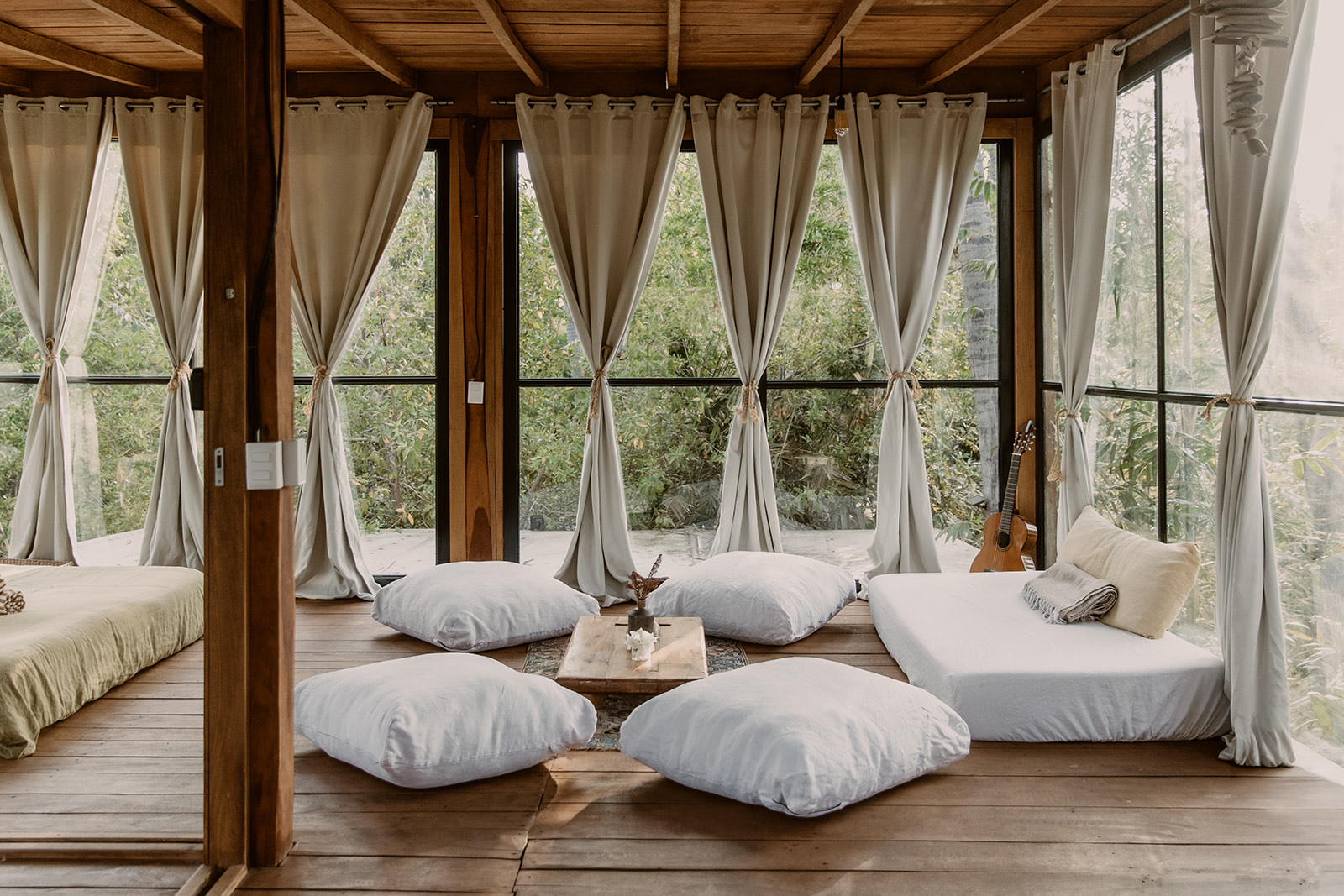
- Light layers for evenings — the shala is open-air; evenings in the January or October window can be pleasant but slightly cool
- Sandals or light shoes for the property
- Swimsuit for the pool and ice bath (separate from surf gear or the same — your call)
- Personal prescription medications — sufficient for the trip plus a few days' buffer
- Anti-diarrheal medication (e.g., Imodium) — standard Mexico travel preparation, used by most first-time visitors at some point
- Insect repellent — useful for evenings on the terrace; mosquitos are present year-round in coastal Guerrero
- Basic first aid: pain reliever, antihistamine, blister care, band-aids
- SPF lip balm
- Travel insurance documentation — keep a digital copy accessible
- Passport — valid for at least six months beyond your travel dates
- Copy of FMM tourist permit (issued on arrival; keep with passport)
- Cash pesos for off-property spending — 3,000 to 5,000 pesos is sufficient for most four-day visits. Withdraw from an ATM in Zihuatanejo on arrival rather than at the airport if possible.
- A credit card for backup — Visa and Mastercard are accepted at established restaurants; less reliable at small village vendors
Health, food, water, and safety
La Saladita is a small Pacific fishing village that has welcomed international travelers for decades. It is not a concerning destination for health or safety. The relevant facts, stated plainly:
Food and water at the property are safe. The kitchen filters the water used for cooking and produce washing. Drinking water at the property is filtered or bottled; you will never be handed a glass of unfiltered tap water. Off-property, at the established local restaurants — Paco's, Crispy Fish, Marejada, Lourdes, Acadia — food is reliably safe by the standards of any reputable small Mexican restaurant. Standard Mexico travel precautions apply: do not drink tap water from bathroom faucets, be sensible about ice at unfamiliar establishments, pack the anti-diarrheals and use them if needed. They are not a sign that something went wrong; they are standard equipment for a week in tropical Mexico.
The ocean is clean. La Saladita's beach is a fishing village beach without significant industrial or sewage runoff. The water quality is suitable for surfing and swimming.
Security in La Saladita village and on the ZIH-to-Saladita corridor is not a concern. The elevated travel advisories that affect parts of Guerrero state apply to Acapulco and to certain highway corridors south and east of Zihuatanejo; they do not apply to the north coast corridor or to La Saladita itself. Thousands of international surf travelers use the ZIH–La Saladita route every season without incident. We have not had any security incidents at the property.
Standard sensible travel habits apply: use vetted transfers rather than unmarked vehicles, keep valuables in room safes, avoid walking alone on the beach after dark. Beyond that, La Saladita is the kind of village where people leave their sandals outside restaurant doors and the main activity after dark is dinner and conversation.
Currency, tipping, and practical money
The retreat fee is settled in USD by invoice before arrival, so you will not need to pay for accommodation, meals, or sessions in cash. For everything off-property — gratuities, restaurant visits in the village, any gear or souvenirs — cash pesos are the most convenient option.
The best place to get pesos is at a bank ATM in Zihuatanejo. The airport ATM at ZIH is functional but the exchange rate is slightly worse than in-town. Your US, Canadian, or European bank card will work at Mexican bank ATMs (HSBC, Santander, Banamex); check your bank's international withdrawal fees before travel. Notify your bank of the Mexico travel dates to avoid a card being flagged.
On tipping: gratuities are meaningful in La Saladita in a way that differs from tipping at a large resort. At village restaurants, 10–15 percent of the bill is the norm. For the local surf guides, 200 to 300 pesos per person after a morning session (roughly $10–15 USD) is appropriate; more if the guide worked closely with you. For property staff at the end of the stay, 500 to 1,000 pesos per person across the four days is a reasonable contribution, divided among kitchen and housekeeping. The property and the village are small; tips constitute a significant part of income for the people who make the experience work.
A note on connectivity
La Saladita has cellular service from the Mexican carriers (Telcel and Movistar dominate coverage in this part of Guerrero). US phones on T-Mobile operate on their standard Mexico plan without additional cost. AT&T and Verizon customers should verify their Mexico international plan before travel; the per-day options are typically affordable. UK, Australian, and European carriers vary; check your plan.
The property has Wi-Fi. It is reliable for standard work tasks — video calls, email, document access — though it is not a gigabit connection. File downloads or large video uploads are better done before arrival. There is no expectation of being offline; the retreat does not require it.
Questions about travel logistics? Write us at hello@templosaladita.com