Before the schedule begins
Most retreat descriptions come from marketing departments. This one comes from the people who run it. We want you to know what the four days actually look like — specific enough that you can decide whether the format is right for you, not so precisely choreographed that there is nothing left to discover when you arrive.
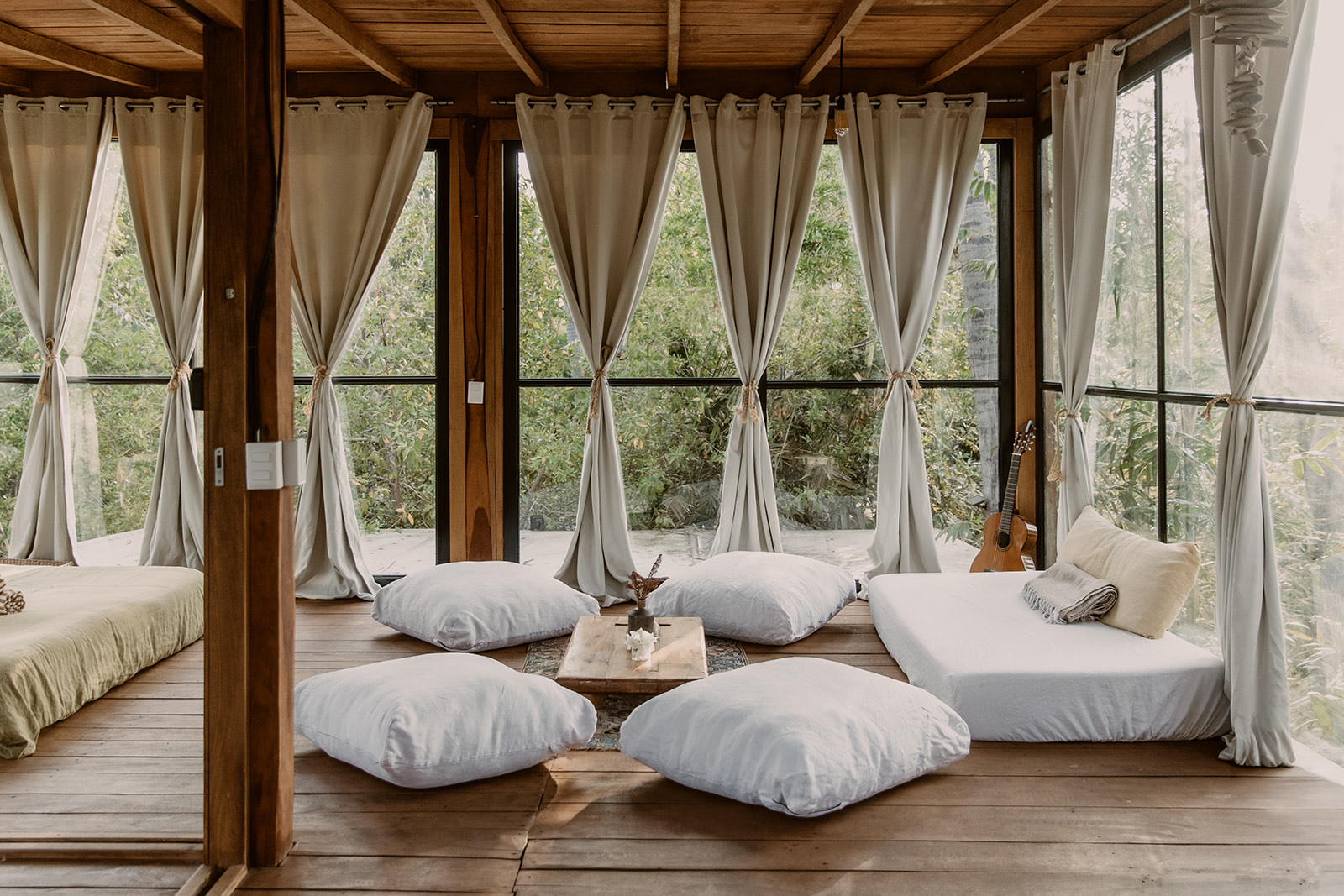
The retreat runs Wednesday through Saturday. The property at La Saladita is yours for those four days: all five spaces, the hexagonal shala, the pool, the two plunge ice baths, the barrel sauna, the edible gardens. There are no other guests. Eight operators and the property's small staff team.
The daily architecture is not accidental. Breathwork and movement before the heat. Surf session with local guides while the water is glassy and the sets are most consistent. A facilitated peer session in the shala when everyone is back, warm, and slightly undone by the morning. Unstructured afternoon — the pool, the ice bath, the hammock, a walk to the point. Dinner together at the long table, long, with wine. Then the working session, which is the densest part of the day and benefits from everything that preceded it.
Over four days, the architecture moves: from arrival and orientation on Wednesday evening, through two full working days on Thursday and Friday, to a closing half-day on Saturday that is designed for integration rather than summary. No keynote. No closing-circle exercise. No action-item template. Saturday morning is the ocean and a final session, and then people leave for their flights.
Wednesday — arrival day
The afternoon before it starts
2–5pm
Arrivals from ZIH airport. The coordinated transfer from Zihuatanejo takes approximately 45 minutes north along the coast highway. Participants arrive into individual spaces — one of the five casitas or the glass treehouse — and have a few hours to settle in. The beach is a one-minute walk from the property gate; most people go directly.
5–6:30pm
Informal gathering time. The pool and shared spaces are open. This is not a structured session — it is the hour before the hour, when the group begins to find its rhythms. Jordan is on the property. Drinks are available. The conversation that starts here often continues for the rest of the week.
6:30pm
Opening dinner at the long table at the property. Cooked on-site. Long. The meal is the first structured moment: Addie opens briefly, not with a keynote but with a framing — what the four days are for and what they are not. Each participant says a sentence or two about what they are working on. Not a pitch, not a talk, just a sentence: the problem in its plainest form. This is the first time the group hears each other, and it sets the register for everything that follows.
8:30–10pm
First evening session in the shala. The purpose of this session is not work — it is calibration. We spend roughly ninety minutes establishing how the peer sessions operate: the structure, the expectations, what candor means in practice. Addie runs it. By the end, each participant has had a chance to say more about what they are bringing to the week, and the group has had a chance to ask clarifying questions. No problem-solving yet. That begins Thursday.
10pm
The evening closes. Most participants are up before 6am on Thursday. The property quiets.
Thursday — first full day
The morning earns the evening
6–6:40am
Breathwork in the shala. Open to all, led by Jordan, approximately forty minutes. The shala is an open-air hexagon in the palm canopy — no walls, the sound of the ocean close. The breathwork is not demanding; it requires no prior experience and is designed as a gentle threshold between sleep and the surf session. Some participants have a breathwork practice already; others are encountering it for the first time. Both are fine.
7–10am
Surf session. Local Saladita guides meet the group at the beach. The guides have worked this lineup for years and assess each participant's level quickly — soft-top learner boards for beginners, longboards for intermediate and experienced surfers. La Saladita is a long, slow left-hand point break; rides run several hundred meters from the point to shore. The wave is mellow enough for a first session and consistent enough to be interesting for experienced surfers. Guides work in the water with the group for approximately two to three hours, depending on conditions and energy. The surf session is the morning practice. It is not a lesson in the traditional sense; it is a shared physical experience in an unfamiliar medium. That is the point.
10–10:30am
Breakfast at the property. Served at the long table beginning at 7am for early risers, with the main spread available through mid-morning for those returning from the water. Local fruit, eggs, fresh bread, coffee, juice. The kitchen team is on through mid-morning; there is no rush to eat at a particular time.
10:30am–12:30pm
First facilitated peer session in the shala. This is the substantive work. One participant — whoever the group has agreed to start with — presents their situation for fifteen to twenty minutes: the company, the specific problem, where they are stuck and why. The group then spends forty to sixty minutes responding: questions, observations, analogies from their own experience, pushback where warranted. Addie facilitates to keep the exchange specific and useful rather than abstract or reassuring. The session is not therapy and it is not coaching — it is peer exchange with structure. Typically one full participant session per morning, plus a briefer second if time allows.
12:30–6:30pm
Unstructured. Lunch is available at the property. After that, the afternoon belongs to individuals. The pool. The two plunge ice baths — one shared in the compound, one private in the treehouse. The barrel sauna in the treehouse. Hammocks. The edible garden, which produces herbs and fruit throughout the stay. The beach, a minute away, for a second time in the water or simply to sit. Some participants use the afternoon for calls or email. Some read. Some sleep. The point of leaving it unscheduled is that each person fills it differently, and that difference is part of what the group learns about each other.
6:30–8pm
Dinner. Cooked at the property. The table seats eight easily; the kitchen team prepares a full meal. Wine is on the table. The conversation from the morning session often surfaces here in a different register — less formal, more lateral, the kind of connective thinking that happens when the pressure of the structured session is off.
8–10pm
Evening working session. This is where the day's arc completes. The morning session introduced a problem; the evening session returns to it with the benefit of a full day of shared experience. A second participant may bring their problem to the group, or the evening may deepen the Thursday morning discussion. Addie runs the structure. By this point in the day, the performance reflex that most operators carry into professional conversations has been somewhat interrupted — by the surf, by the afternoon, by the dinner. The evening sessions typically produce more candor than the morning ones, and the morning ones are already better than most professional conversations participants have had in the prior year.
Friday — deepest day
The group already knows each other now
Friday runs the same architecture as Thursday — breathwork, surf, facilitated morning session, unstructured afternoon, dinner, evening session — with one significant difference: the group has been together for thirty-six hours. The dynamics have shifted. People know each other. The peer sessions are shorter in the orientation phase and deeper in the substance. The afternoon conversations are harder to plan because they have already started at breakfast.
6–6:40am
Breathwork in the shala. The second morning tends to have higher attendance than the first — participants who were cautious on Thursday often show up Friday having decided they wanted it.
7–10am
Surf session. Local guides return. The second morning in the water is noticeably different from the first for most participants: the wave is familiar now, the body has some memory of it, and the guides can push the session further. Intermediate and experienced surfers often have their best rides of the week on Friday. Beginners have usually found a version of standing up by now, which changes the experience of being in the ocean entirely.
10:30am–12:30pm
Facilitated peer session. Friday morning typically covers two full participant problems — the group is faster now, the questions are more precise, and people have less need to establish credibility before being direct. The sessions have a different quality by this point: the group has surfed together twice, eaten together three times, stayed up later than intended. That shared context is visible in the work.
12:30–6:30pm
Unstructured afternoon. The Friday afternoon tends to be the most social of the three — smaller conversations that have been building all week surface here. The ice bath in the afternoon is a ritual by Friday for those who want it. The treehouse sauna has usually gathered a group by 4pm.
6:30–8pm
Dinner. Friday dinner is typically the longest of the week — the conversation does not want to stop for the session.
8–10pm
Evening working session. Friday evening often becomes the session where the harder things get said. By this point participants have enough relational credit with each other to offer the kind of direct observation that is usually reserved for close friends or trusted advisors — not because the retreat has made them close friends (though it sometimes does), but because the format has created the conditions for directness without performance. Friday evening is typically the densest session of the week.
The day is designed so the physical morning earns the intellectual evening. Four days of that compound.
Saturday — closing morning
Integration, not summary
Saturday is a half-day. The goal is integration — letting the week land — not productivity. There is no closing keynote, no action-item exercise, no group commitment to stay in touch. The group will either stay in touch or it won't; that depends on the people, not on the program.
6–8am
Optional early surf session. Local guides are available Saturday morning for participants who want one more session. It is genuinely optional — some participants sleep in, some sit with coffee on the property terrace, some are already mentally on the plane. The water is there for those who want it.
7am onward
Breakfast served at the long table, beginning at 7am for those who want it early and running through the morning.
8:30–10am
Final closing session in the shala. Not a recap and not a keynote. Addie opens with a short framing: what the group covered, what they did not, what tends to happen in the weeks after a session like this. Then the floor is open — each participant has a few minutes to say what they are taking with them and what they are leaving behind. This is not a performance and it is not processed; it is a brief honest account from each person. The session ends with nothing scheduled after it, which is the right way for it to end.
10–11am
Departures. We coordinate group transfers to ZIH airport for participants catching early afternoon flights. The drive is 45 minutes. Participants extending their stay in the area check out of property spaces by noon; luggage storage is available at the property while you spend the day in the village or on the beach.
What the four days do
The architecture over four days is designed to move through three phases. Wednesday and Thursday morning: orientation and establishment — the group finds its register, each person stakes out what they are working on, the facilitators calibrate to the room. Thursday afternoon through Friday: depth — the sessions get better as the shared experience accumulates, the unstructured time does its work, people take risks they would not have taken forty-eight hours earlier. Saturday: landing — not summary, not celebration, but the quiet consolidation of whatever happened.
The physical rhythm — breathwork, surf, session, afternoon, dinner, session — is not decoration. Most executive peer programs run in conference rooms and coffee breaks. The body is absent. The result is a conversation that could have happened over Zoom, except with worse posture and a more expensive hotel room. The body's presence changes the conversation. The surf session in particular — two or three hours in an unfamiliar physical medium, guided by people who know this wave better than anyone, where status and credential cannot be performed — changes how people arrive at the table afterward. The evening sessions would not be as good without the morning ones. That is the architecture.
There is no keynote speaker. There is no whiteboard. There are no slides. The only deliverable is the conversation, and the conversation is yours.
Questions about the format? Write us at hello@templosaladita.com
Frequently asked questions about scheduling
What time should I arrive on Wednesday?
The recommended arrival window is 2pm to 5pm local time. This gives you time to settle, walk to the beach, and be present for the opening dinner at 6:30pm. We coordinate group transfers from ZIH in the early-to-mid afternoon. If your flight schedule requires an earlier or later arrival, let us know in the pre-retreat logistics email and we will sort the transfer.
What time does the retreat end on Saturday?
Saturday morning runs from approximately 6am to 11am. The final closing session ends around 10am. Most participants depart for ZIH airport between 10:30am and noon to catch early afternoon flights. We coordinate group transfers on Saturday morning. If you are extending your stay, check-out is by noon and luggage storage is available.
How much is structured vs. unstructured time?
Roughly forty percent of waking hours are in structured programming — breathwork, surf, facilitated sessions, evening working sessions. The remaining sixty percent is genuinely unstructured afternoon time. The open afternoon is not filler; it is the recovery window that makes the evening sessions possible. Executives who run on fully packed schedules sometimes experience the first open afternoon as disorienting, and then as the most valuable part of the day.
Is the breathwork session mandatory?
No. The 6am breathwork session is offered and unforced. Participants who prefer a slower start can use the time for quiet work or rest without friction. No prior breathwork experience is needed. Roughly two-thirds of participants attend each morning in practice.
Can I spend time off the property during the retreat?
Yes, during unstructured afternoon time. La Saladita village has restaurants (Paco's, Crispy Fish, Marejada) within walking distance. The beach is a minute from the property gate. The only ask is to be back at the property for dinner, where the evening sessions begin. Most participants choose to stay on the property during the afternoon — it is genuinely pleasant enough — but the village is accessible.